

No products in the basket.
ESP & IOT, Wifi Modules, Wireless & Communication, Wireless Modules
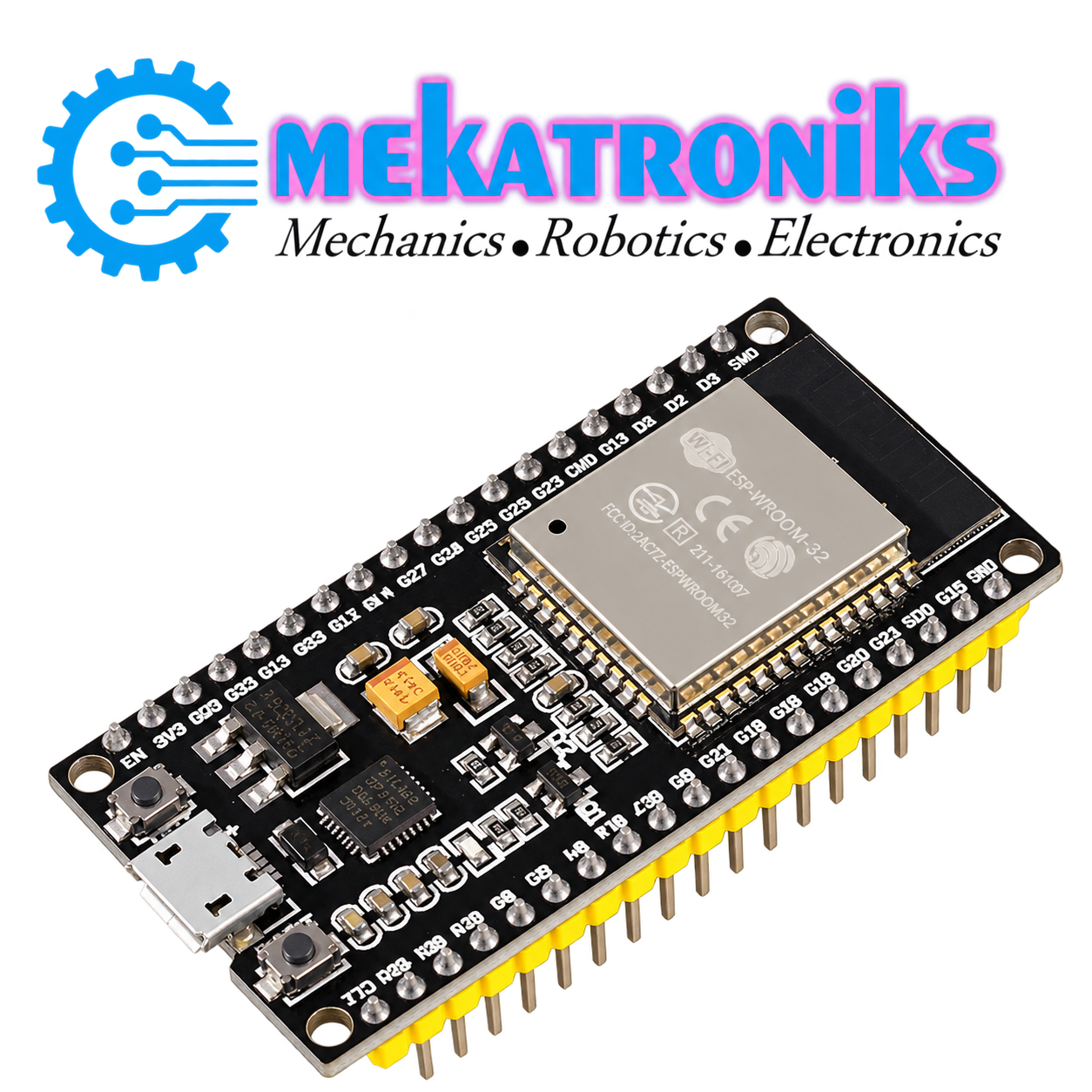
38 Pin NodeMCU ESP32S Development Board – ESP-WROOM-32 WiFi & Bluetooth CH9102X
Build connected electronics projects with the 38 Pin ESP32 Development Board, featuring an ESP-WROOM-32 module with WiFi and Bluetooth connectivity. Its CH9102X USB-to-serial interface supports programming and serial communication through a computer. A practical choice for students, hobbyists and developers working on IoT, automation and sensor projects in Pakistan.
₨ 1,150
he 38 Pin ESP32 Development Board brings wireless connectivity and flexible microcontroller features to your electronics projects. This NodeMCU ESP32S board uses an ESP-WROOM-32 module and a CH9102X USB-to-serial interface, allowing you to upload programs and monitor serial data from your computer.
Whether you are learning embedded programming or developing a connected prototype, this board provides a useful starting point. Use it to read sensors, control external circuits and exchange data over a wireless connection.
WiFi and Bluetooth Connectivity
Connect your projects to a compatible 2.4 GHz WiFi network for wireless monitoring and control. The ESP-WROOM-32 also supports Bluetooth Classic and Bluetooth Low Energy, giving you options for communication with compatible devices.
Create a local monitoring interface, send sensor readings to an online service or build a Bluetooth-controlled project. These features make the board useful for experimenting with connected electronics.
Flexible Interfaces for Electronics Projects
The ESP32 supports common interfaces such as UART, SPI and I2C. These allow you to connect compatible sensors, displays and other peripheral modules. It also provides analogue input and PWM capabilities for measurement and control tasks.
The board has 38 header pins in total, including power and ground connections. These are not 38 independent GPIOs. Check the board’s pinout before wiring, as some ESP32 pins have input-only functions or boot-related restrictions.
Programming and USB Communication
The CH9102X interface provides USB-to-serial communication for firmware uploads and debugging. Depending on your computer’s operating system, you may need to install a compatible driver before the serial port appears.
Choose an ESP32-compatible programming environment and select settings appropriate to your board. Always check the connected port and board configuration before uploading your program.
Project Applications
- WiFi temperature and humidity monitoring
- Smart home automation prototypes
- Bluetooth-controlled robotics
- Wireless sensor data logging
- IoT learning and university projects
- Display and sensor integration
- Remote monitoring and control systems
Use suitable external drivers when controlling motors, relays or other loads.
Technical Specifications
| Feature | Specification |
|---|---|
| Board type | NodeMCU ESP32S development board |
| Wireless module | ESP-WROOM-32 |
| Header pin count | 38 total pins |
| USB-to-serial interface | CH9102X |
| Processor | Dual-core Xtensa LX6, up to 240 MHz |
| SRAM | 520 KB |
| WiFi | 2.4 GHz 802.11 b/g/n |
| Bluetooth | Bluetooth 4.2 Classic and BLE |
| Interfaces | UART, SPI and I2C |
| Additional capabilities | ADC, DAC, PWM and capacitive touch |
| GPIO logic level | 3.3V |
Connection and Power Guidance
The ESP32 uses 3.3V GPIO logic. Do not connect 5V signals directly to its GPIO pins. Use a suitable level shifter when connecting devices with higher signal voltages.
Follow the development board’s power-input markings and pinout. Power motors and other high-current devices through an appropriate external supply and driver circuit.
ESP32 Development Board for Pakistan
Explore embedded programming and wireless electronics with this 38 Pin ESP32 Development Board from Mekatroniks. It is suited to students, makers and developers in Pakistan building sensor systems, automation prototypes and IoT projects.
Package includes:
1 × 38 Pin NodeMCU ESP32S ESP-WROOM-32 Development Board with CH9102X USB-to-serial
Based on 0 reviews
Be the first to review “38 Pin NodeMCU ESP32S Development Board – ESP-WROOM-32 WiFi & Bluetooth CH9102X”
Related products
- Components & Small Parts, Developments Boards, ESP & IOT, Wifi Modules, Wireless & Communication, Wireless Modules
ESP32 C3 Super Mini Development Board in Pakistan
 Components & Small Parts, Developments Boards, ESP & IOT, Wifi Modules, Wireless & Communication, Wireless Modules
ESP32 C3 Super Mini Development Board in Pakistan
About
- Powerful processor:
- ESP32-C3 equipped with a single-core
- 32-bit RISC-V processor with a main frequency
- up to 160 MHz. Built-in 400KB and 384KB ROM storage
SKU: n/a


There are no reviews yet.